LEADING EDGE PROTECTION

Leading edge protection & erosion repair

Protect the edge that takes the impact.

Leading edge erosion repair, protective film, liquid foil and surface restoration for wind turbine blades.

Discuss this service ↗

From erosion to protection

Leading edge work starts with the condition of the existing surface. The team reviews the damaged area and proposed protection system so preparation, restoration and application can be planned as one scope.

SERVICE SCOPE

↗  Leading edge erosion repair
↗  Surface preparation and restoration
↗  Liquid foil and protective film
↗  Application and completion records

BEFORE & AFTER

When leading-edge erosion becomes a performance issue

This is one of the most visible examples of why wind turbine blade maintenance cannot be treated as cosmetic work.

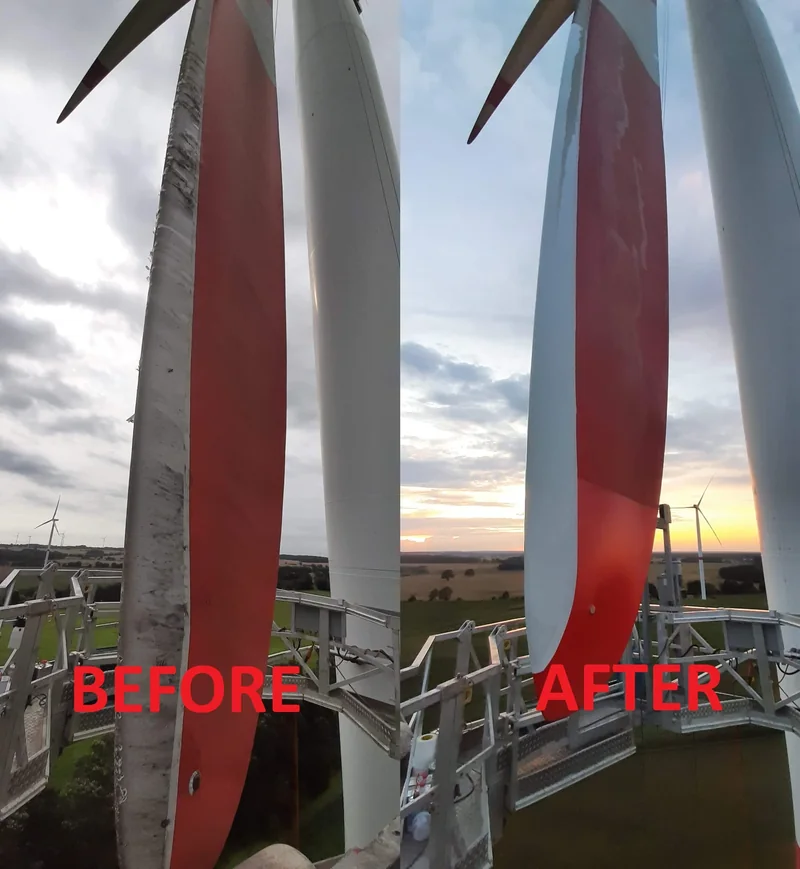
Before and after leading-edge repair: severe surface degradation on the left, restored contour and protective surface on the right
Before: severe leading-edge degradation. After: restored contour and protected surface.

The “before” photo shows severe surface degradation along the blade’s leading edge. The “after” photo shows the geometry restored and the surface protected again.

But the real objective of this work is not simply to make the blade look new.

The leading edge is one of the most aerodynamically sensitive areas of a wind turbine blade.

During operation, this area is continuously exposed to rain, airborne particles, insects and other environmental impacts. Over time, erosion can progress from minor coating degradation to significant surface roughness and material loss.

Surface condition matters

A rough or damaged leading edge can disturb the intended airflow around the blade profile. As degradation progresses, it may influence aerodynamic efficiency and eventually require increasingly extensive repair.

A controlled repair process

Professional leading-edge repair follows a controlled process:

  1. Assess the extent of damage.
  2. Remove degraded material.
  3. Prepare a sound and correctly profiled substrate.
  4. Repair defects where required.
  5. Restore the aerodynamic contour.
  6. Apply the specified protective system.
  7. Inspect and document the completed work.

Geometry is one of the most important points

A technically sound repair is not achieved simply by adding material and applying a new coating.

The repaired area must transition smoothly into the original blade profile. Excessive material, uneven finishing or poor transitions can create their own aerodynamic disturbance.

The difference between these two photos therefore represents much more than appearance.

It represents the restoration of a functional aerodynamic surface designed to operate under demanding conditions for thousands of hours.

Blade maintenance is not about making damage disappear.

It is about restoring the blade as close as possible to the condition the engineering requires.

And that is where workmanship, process control and final inspection make the difference.

Help us assess your project.

Include the site location, turbine and blade model, inspection findings or photographs, and your preferred work window. Scope and mobilisation are confirmed after technical review.

projects@dvinblade.com ↗

Planning your project

What is leading edge protection (LEP)?

Leading edge protection is applied to the blade edge exposed to erosion. DvinBlade supports erosion repair, surface restoration, protective film and liquid foil application, with the proposed system reviewed for the project.

Does an eroded blade need preparation before protection?

The condition of the existing surface is reviewed before application. Preparation, erosion repair and restoration are planned together with the protection system; applying protection is part of that agreed scope.

What should I send for a leading edge repair enquiry?

Include the blade model, photographs of the affected edge, the existing coating or protection system if known, site location and work window. These details help define surface preparation and application requirements.

LET’S DISCUSS YOUR PROJECT

For assets that deserve
exceptional care.

Share your inspection report, blade defect or project scope. Let’s plan the work with the care your assets demand.

Discuss your project